function newtonRaphson(f, df, c, x0, xmin, xmax, tolerance, maxIterations) {
  let x = x0;
  let iter = 0;
  let error = Number.POSITIVE_INFINITY;
  let fmin = f(xmin) - c;
  let fmax = f(xmax) - c;

  if (math.sign(fmin) == math.sign(fmax)) {
    console.warn("The function does not have a solution within the specified range.");

    if (math.abs(fmin) < math.abs(fmax)) {
      return(xmin);
    } else {
      return(xmax);
    }
  } else {
    while (error > tolerance && iter < maxIterations) {
        let fx = f(x) - c;
        let dfx = df(x);
        let step = -fx / dfx;
        let p = 0;
        let xNext = x + step;
        while (xNext <= xmin || xNext >= xmax) {
          xNext = x + step / 2**p;
          p++;
        }
        error = Math.abs(fx);
        x = xNext;
        iter++;
    }

    if (iter === maxIterations) {
        console.warn("Newton-Raphson method did not converge within the maximum number of iterations.");
    }

    return x;

  }
}

function KL_binomial(phi) {
  return N * (math.log(2) + phi * math.log(phi) + (1 - phi) * math.log(1 - phi));
}

function dKL_binomial(phi) {
  return N * (math.log(phi) - math.log(1 - phi))
}

phi = newtonRaphson(KL_binomial, dKL_binomial, Delta, 0.75, 0.50, 0.9999, 1e-5, 100)

binom_pts = N + 1

dat2 = Array(binom_pts).fill().map((element, index) => {
  let x = index;
  let p = binomial.pmf(index, N, phi);
  let q = binomial.pmf(index, N, 0.5);
  return ({
    x: x,
    p: p,
    q: q
  })
})Interactive, data-driven visualizations on static web pages
using Observable.js and Quarto
James E. Pustejovsky
2026-09-01
James E. Pustejovsky
(“PUHS-tea-UV-ski” or “Pusto” for short)
Full Professor in Educational Psychology, Quantitative Methods Program
PhD in Statistics (Northwestern University, 2013)
Applied statistician & methodologist
Main research focus is research synthesis and meta-analysis.
Long-time R programmer (pre-tidyverse).
Not a web developer or software engineer.
Observable.js
JavaScript dialect designed by Mike Bostock for use with browser-based Observable notebooks.
Created by Mike Bostock
Includes intuitive plotting library
Includes simple interactive input library
Quarto (
.qmd) can include Observable cells as{ojs}On static html pages
In
reveal.jspresentations (like this one)
Useful for
Building intuitions about statistics
Teaching
Presenting research findings

Model Fit Criteria
Widely used measures of model fit (AIC, DIC, WIC, LOOIC) are defined in terms of Kullback-Leibler divergence.
- How do you interpret differences in model fit measures?

Suppose we have two models fit to the same data. The models differ in fit by some amount \(\Delta\).
One approach to interpreting is calibration
- Find two simpler-to-conceptualize models that have the same difference in KL-divergence.
Coin flip calibration
Imagine you are flipping a coin \(N\) times and that you expect the coin to be fair.
- Your mental model is that the number of heads \(H \sim Binom\left(N, \frac{1}{2}\right)\).
The coin is actually biased with probability of heads \(\phi\).
\[ \Delta = KL\left(Bin\left(N,\phi\right), Bin\left(N,\frac{1}{2}\right)\right) = N \times \left[\log 2 + \phi \log \phi + (1 - \phi) \log(1 - \phi)\right]. \]
Standard normal calibrations
normal = require( 'https://cdn.jsdelivr.net/gh/stdlib-js/stats-base-dists-normal@umd/browser.js' )
student = require( 'https://cdn.jsdelivr.net/gh/stdlib-js/stats-base-dists-t@umd/browser.js' )
gamma = require( 'https://cdn.jsdelivr.net/gh/stdlib-js/stats-base-dists-gamma@umd/browser.js' )
trigamma = require( 'https://cdn.jsdelivr.net/gh/stdlib-js/math-base-special-trigamma@umd/browser.js' )

// Location-shift

mu_D = math.sqrt(2 * Delta / N)


// Scale-shift

function KL_sigma(s) {
  return N * (s**2 - 1 - 2 * math.log(s)) / 2;
}

function dKL_sigma(s) {
  return (s - 1 / s) * N;
}

sigma_D = newtonRaphson(KL_sigma, dKL_sigma, Delta, 1.1, 1, 100, 1e-5, 100)

// Skewness

function logKL_gamma(la) {
  let a = math.exp(la);
  let c1 = (math.log(2 * math.pi) + 1) / 2;
  let c2 = gamma.entropy(a, math.sqrt(a));
  return math.log(N) + math.log(c1 - c2);
}

function dlogKL_gamma(la) {
  let a = math.exp(la);
  const c1 = (math.log(2 * math.pi) + 1) / 2;
  let c2 = gamma.entropy(a, math.sqrt(a));
  let c3 = 1 / (2 * a) - 1;
  let c4 = (1 - a) * trigamma(a);
  return a * (c3 - c4) / (c1 - c2);
}

log_Delta = math.log(Delta)
log_alpha = newtonRaphson(logKL_gamma, dlogKL_gamma, log_Delta, -log_Delta, -10, 10, 1e-5, 100)
alpha_D = math.exp(log_alpha)

// Kurtosis

function KL_t(v) {
  let c1 = math.log(2 * math.pi) / 2;
  let c2 = v / (2 * (v - 2));
  let c3 = student.entropy(v);
  return N * (c1 + c2 - c3);
}

function dKL_t(v) {
  let c1 = (v - 2)**(-2);
  let c2 = 1 / (2 * v);
  let c3 = (trigamma((v + 1) / 2) - trigamma(v / 2)) * (v + 1) / 4;
  return -N * (c1 + c2 + c3);
}

nu_D = newtonRaphson(KL_t, dKL_t, Delta, 3, 2, 100, 1e-5, 100)

// Compute densities
pts2 = 201
dat3 = Array(pts2).fill().map((element, index) => {
  let x = - scale + index * 2 * scale / (pts2 - 1);
  let p = normal.pdf(x,0,1);
  let q = normal.pdf(x, mu_D, 1);
  let r = normal.pdf(x,0, sigma_D);
  let s = gamma.pdf(x + math.sqrt(alpha_D), alpha_D, math.sqrt(alpha_D));
  let t = student.pdf(x, nu_D);
  return ({
    x: x,
    p: p,
    q: q,
    r: r,
    s: s,
    t: t
  })
})

colormap = [{v:"q",c:"blue"},{v:"r",c:"green"},{v:"s",c:"orange"},{v:"t",c:"red"}]

function density_plot(v, c) {
  return Plot.plot({
    height: 200,
    width: 400,
    y: {
      grid: false,
      axis: false,
      domain: [0, 0.45]
    },
    x: {
      label: null
    },
    marks: [
      Plot.lineY(dat3, {x: "x", y: "p", stroke: "black"}),
      Plot.areaY(dat3, {x: "x", y: v, fill: c, fillOpacity: 0.5}),
      Plot.lineY(dat3, {x: "x", y: v, stroke: c})
    ]
  });
}

plot_list = Object.values(colormap).map(x => density_plot(x.v, x.c))Teaching statistics
An example from meta-analysis
Step-function selection models
The data for \(j = 1,...,J\) effect size estimates
\(T_{j}, \sigma_{j} \quad\) estimate and standard error for effect size \(j\)
\(p_{j} = \Phi^{-1}(-T_{j} / \sigma_{j}) \quad\) one-sided \(p\)-value of effect estimate \(j\)
- Random effects model for the evidence-generating process (before selective reporting): \[T_{j} \sim N\left(\ \mu, \ \tau^2 + \sigma_{j}^2 \right)\]
- \(H\)-step model for the selection process with steps \(\alpha_1,...,\alpha_H\) (taking \(\lambda_0 = 1, \alpha_0 = 0, \alpha_{H+1} = 1\)): \[\text{Pr}(\ T_{j} \text{ is observed} \ ) \propto \sum_{h=0}^H \lambda_h \times I(\alpha_{h} \leq p_{j} < \alpha_{H+1})\]
A piece-wise normal distribution
The step-function model implies that the distribution of observed effect size estimates is piece-wise normal.
norm = import('https://unpkg.com/norm-dist@3.1.0/index.js?module')

eta = math.sqrt(tau**2 + sigma**2)
H = 2
alpha = [alpha1, alpha2]
lambda = [1, lambda1, lambda2_ratio * lambda1]
lambda_max = math.max(lambda)

function findlambda(p, alp, lam) {
  var m = 0;
  while (p >= alp[m]) {
    m += 1;
  }
  return lam[m];
}

function findMoments(mu, tau, sigma, alp, lam) {
  let H = alp.length;
  let eta = math.sqrt(tau**2 + sigma**2);

  let gamma_h = Array(H+2).fill(null).map((x,i) => {
    if (i==0) {
      return Infinity;
    } else if (i==H+1) {
      return -Infinity;
    } else {
      return sigma * norm.icdf(1 - alp[i-1]);
    }
  });

  let c_h = Array(H+2).fill(null).map((x,i) => {
    return (gamma_h[i] - mu) / eta;
  });

  let B_h = Array(H+1).fill(null).map((x,i) => {
    return norm.cdf(c_h[i]) - norm.cdf(c_h[i+1])
  });

  let Ai = 0;
  for (let i = 0; i <= H; i++) {
    Ai += lam[i] * B_h[i];
  }

  let psi_h = Array(H+1).fill(null).map((x,i) => {
    return (norm.pdf(c_h[i+1]) - norm.pdf(c_h[i])) / B_h[i]
  });

  let psi_top = 0;
  for (let i = 0; i <= H; i++) {
    psi_top += lam[i] * B_h[i] * psi_h[i];
  }

  let psi_bar = psi_top / Ai;

  let ET = mu + eta * psi_bar;

  let dc_h = c_h.map((c_val) => {
    if (math.abs(c_val) == Infinity) {
      return 0;
    } else {
      return c_val * norm.pdf(c_val);
    }
  });

  let kappa_h = Array(H+1).fill(null).map((x,i) => {
    return (dc_h[i] - dc_h[i+1]) / B_h[i];
  });

  let kappa_top = 0;
  for (let i = 0; i <= H; i++) {
    kappa_top += lam[i] * B_h[i] * kappa_h[i];
  }
  let kappa_bar = kappa_top / Ai;
  let SDT = eta * math.sqrt(1 - kappa_bar - psi_bar**2);

  return ({Ai: Ai, ET: ET, SDT: SDT});
}

moments = findMoments(mu, tau, sigma, alpha, lambda)
Ai_toprint = moments.Ai.toFixed(3)
ET_toprint = moments.ET.toFixed(3)
eta_toprint = eta.toFixed(3)
SDT_toprint = moments.SDT.toFixed(3)
pts = 201
density_dat = Array(pts).fill().map((element, index) => {
let t = mu - 3 * eta + index * eta * 6 / (pts - 1);
let p = 1 - norm.cdf(t / sigma);
let dt = norm.pdf((t - mu) / eta) / eta;
let lambda_val = findlambda(p, alpha, lambda);
return ({
t: t,
d_unselected: dt,
d_selected: lambda_val * dt / lambda_max
})
})viewof mu = Inputs.range(
[-2, 2],
{value: 0.1, step: 0.01, label: tex`\mu`}
)
viewof tau = Inputs.range(
[0, 2],
{value: 0.15, step: 0.01, label: tex`\tau`}
)
viewof sigma = Inputs.range(
[0, 1],
{value: 0.25, step: 0.01, label: tex`\sigma_i`}
)
viewof alpha1 = Inputs.range(
[0, 1],
{value: 0.025, step: 0.005, label: tex`\alpha_1`}
)
viewof alpha2 = Inputs.range(
[0, 1],
{value: 0.50, step: 0.005, label: tex`\alpha_2`}
)
viewof lambda1 = Inputs.range(
[0, 2],
{value: 1, step: 0.01, label: tex`\lambda_1`}
)
viewof lambda2_ratio = Inputs.range(
[0, 2],
{value: 1, step: 0.01, label: tex`\lambda_2 / \lambda_1`}
)Plot.plot({
height: 500,
width: 1000,
y: {
grid: false,
label: "Density"
},
x: {
label: "Effect size estimate (Ti)"
},
marks: [
Plot.ruleY([0]),
Plot.ruleX([0]),
Plot.areaY(density_dat, {x: "t", y: "d_unselected", fillOpacity: 0.3}),
Plot.areaY(density_dat, {x: "t", y: "d_selected", fill: "blue", fillOpacity: 0.5}),
Plot.lineY(density_dat, {x: "t", y: "d_selected", stroke: "blue"})
]
})Displaying Simulation Study Results
Simulation Design
| Parameter | Full Simulation | Bootstrap Simulation |
|---|---|---|
| Overall average effect | 0.0, 0.2, 0.4, 0.8 | 0.0, 0.2, 0.4, 0.8 |
| Between-study heterogeneity | 0.05, 0.15, 0.30, 0.45 | 0.05, 0.45 |
| Within-study heterogeneity ratio | 0.0, 0.5 | 0.0, 0.5 |
| Correlation between outcomes | 0.4, 0.8 | 0.8 |
| Selection probability | 0.02, 0.05, 0.10, 0.20, 0.50, 1.00 | 0.05, 0.20, 1.00 |
| Number of primary studies | 15, 30, 60, 90, 120 | 15, 30, 60 |
| Primary study sample sizes | Typical, Small | Typical, Small |
2000 replications per condition
399 bootstraps per replication
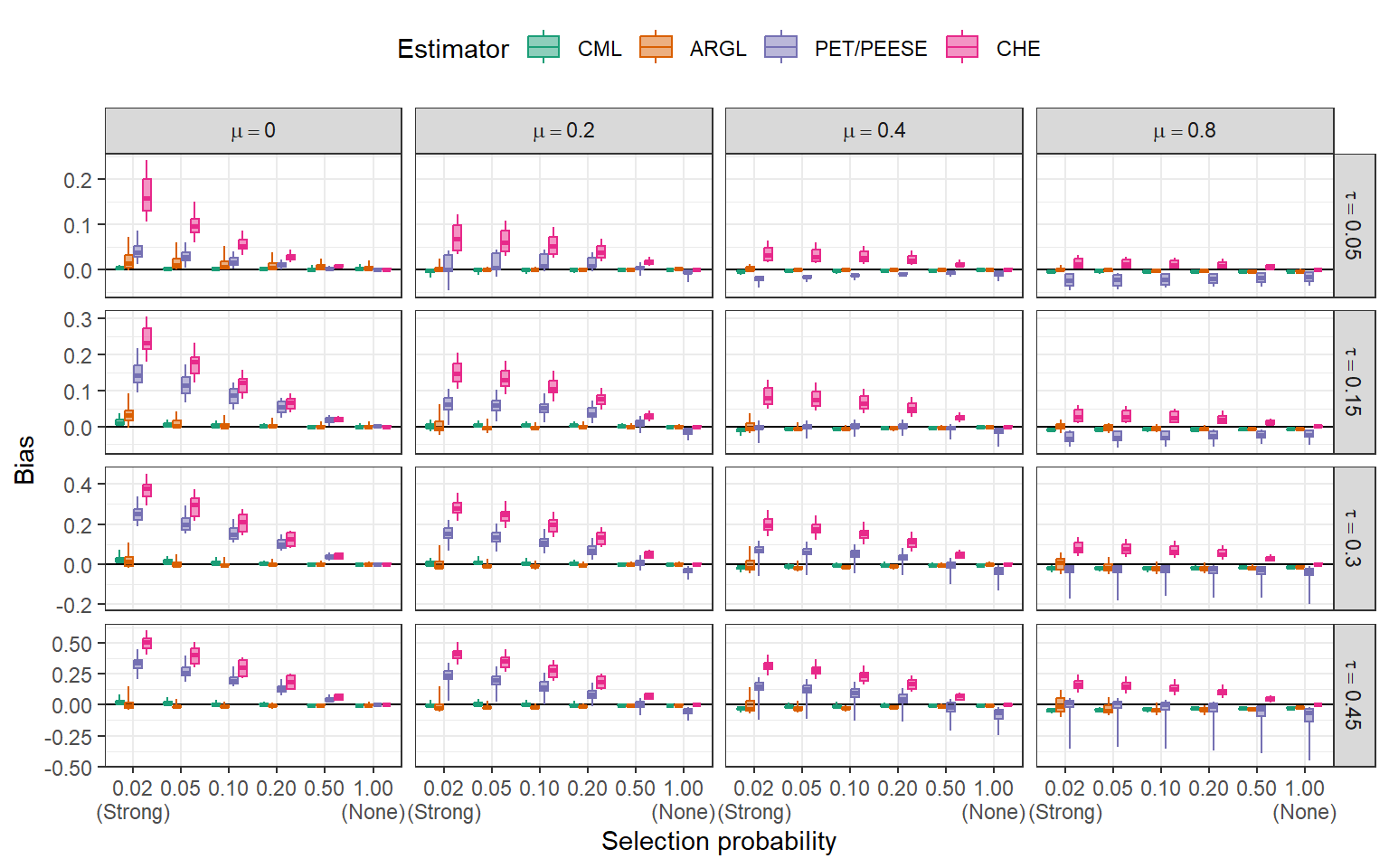
Bias for mean effect size \((\mu)\)
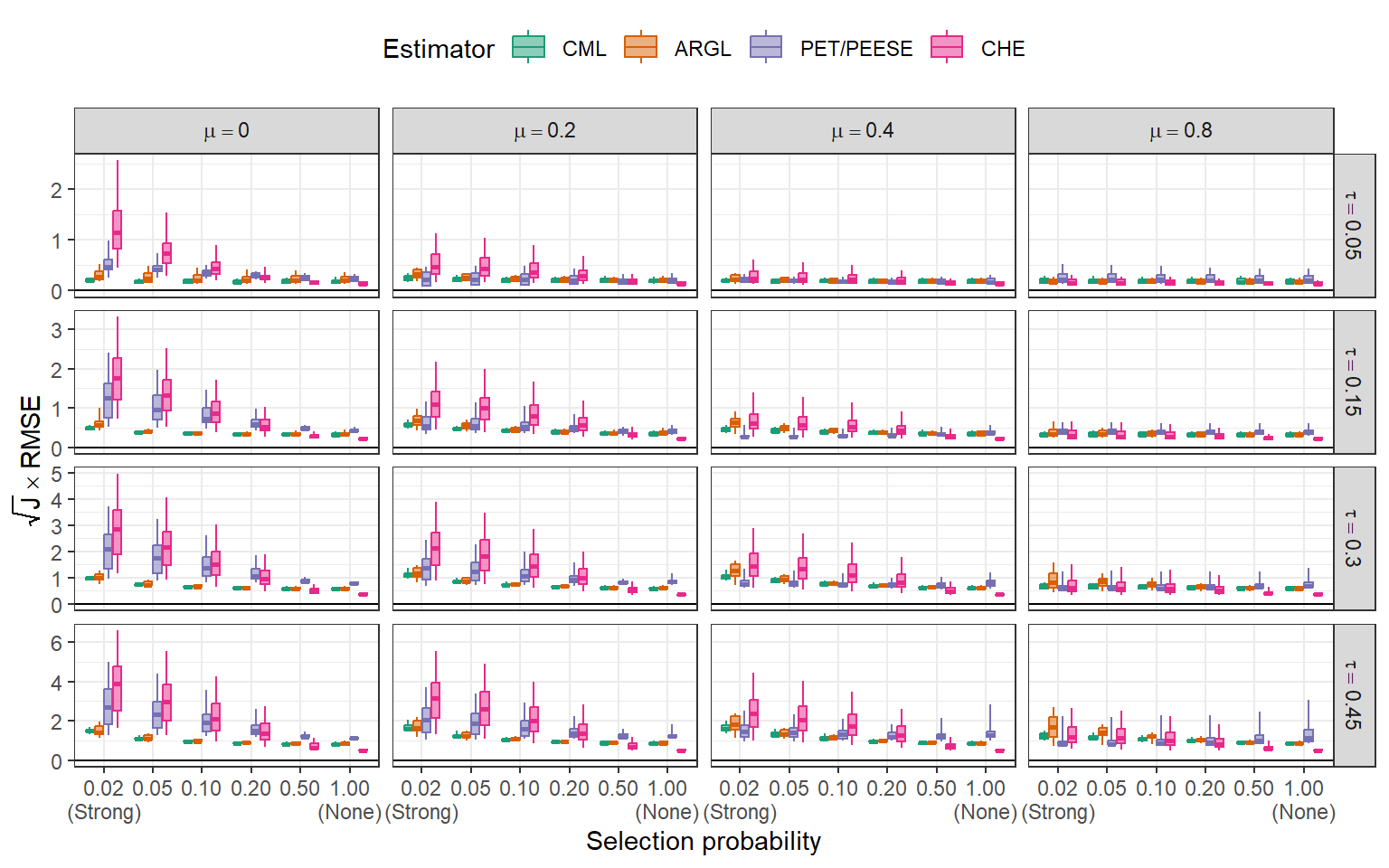
Accuracy for mean effect size \((\mu)\)
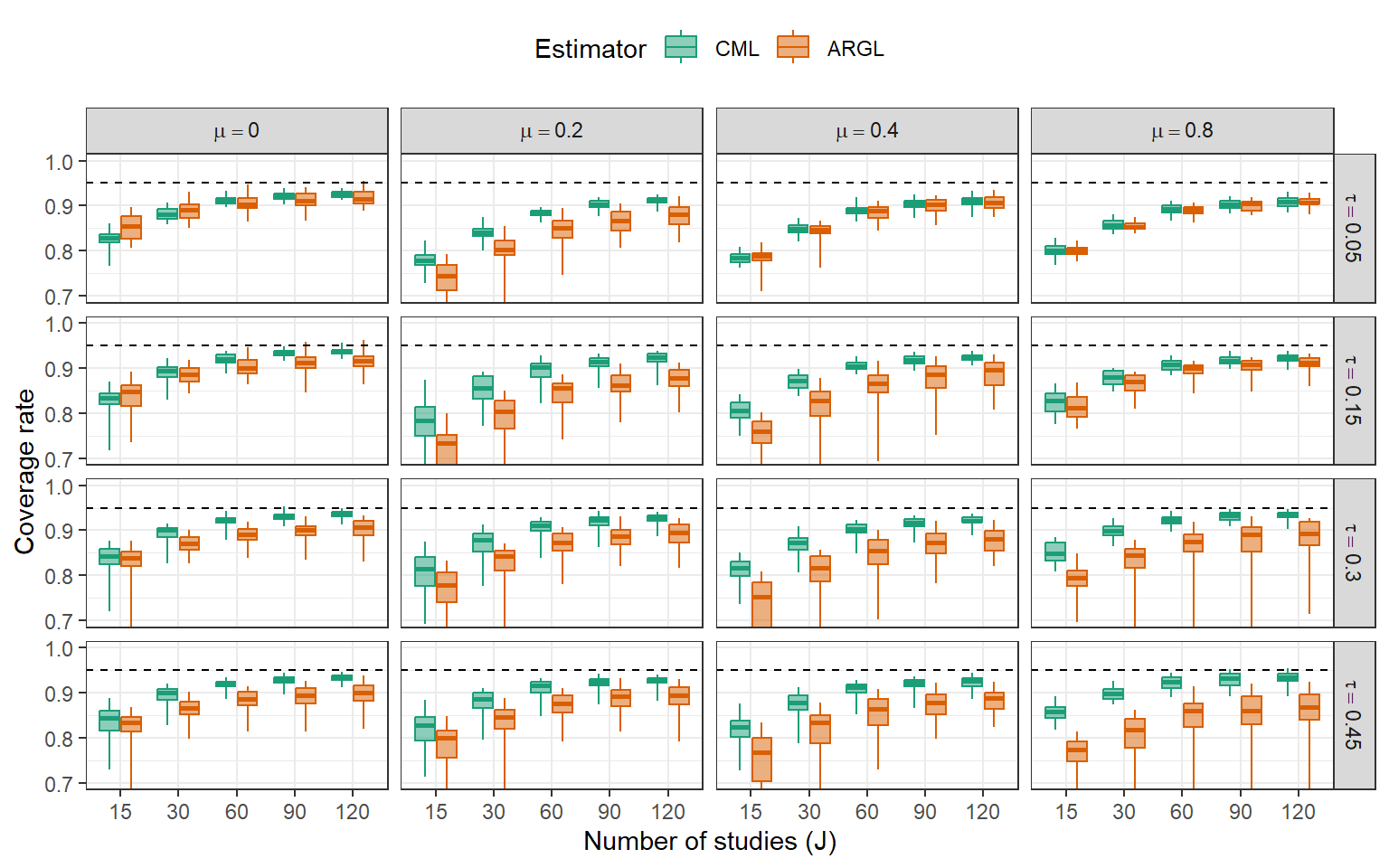
Coverage rates of large-sample (sandwich) CIs
Bias for mean effect size \((\mu)\)
Plot.plot({
  x: {
    domain: ["CML","ARGL","PET/PEESE","CHE"],
    label: null,
    axis: null
  },
  fill: {
    domain: ["CML","ARGL","PET/PEESE","CHE"],
  },
  y: {
    grid: true,
    domain: [-0.1,0.4]
  },
  fx: {
    padding: 0.10,
    label: "Selection probability",
    labelAnchor: "center"
  },
  width: 800,
  height: 500,
  color: {
    domain: ["CML","ARGL","PET/PEESE","CHE"],
    legend: true
  },
  marks: [
    Plot.ruleY([0.0], {stroke: "black"}),
    Plot.boxY(bias_dat, {fx: "weights", x: "estimator", y: "bias", stroke: "estimator", fill: "estimator"})
  ]
})
Accuracy for mean effect size \((\mu)\)
Plot.plot({
  x: {
    domain: ["CML","ARGL","PET/PEESE","CHE"],
    label: null,
    axis: null
  },
  fill: {
    domain: ["CML","ARGL","PET/PEESE","CHE"],
  },
  y: {
    grid: true,
  },
  fx: {
    padding: 0.10,
    label: "Selection probability",
    labelAnchor: "center"
  },
  width: 800,
  height: 500,
  color: {
    domain: ["CML","ARGL","PET/PEESE","CHE"],
    legend: true
  },
  marks: [
    Plot.ruleY([0.0], {stroke: "black"}),
    Plot.boxY(bias_dat, {fx: "weights", x: "estimator", y: "scrmse", stroke: "estimator", fill: "estimator"})
  ]
})
Coverage rates of 95% CIs for \(\mu\)
viewof mu_CI = Inputs.select(
    [0.0,0.4,0.8],
    {
      value: 0.0,
      label: tex`\mu`,
      width: "100px"
    }
  )

viewof tau_CI = Inputs.select(
    [0.05,0.15,0.30,0.45],
    {
      value: 0.05,
      label: tex`\tau`,
      width: "100px"
    }
  )

viewof estimator = Inputs.select(
    ["CML","ARGL"],
    {
      value: "CML",
      label: "estimator",
      width: "100px"
    }
)Plot.plot({
x: {
axis: null
},
y: {
grid: true,
domain: [0.70,1.00]
},
fx: {
padding: 0.10,
label: "Number of studies (J)",
labelAnchor: "center"
},
color: {
legend: true
},
width: 800,
height: 500,
marks: [
Plot.ruleY([0.95], {stroke: "black", strokeDasharray: "5,3"}),
Plot.boxY(coverage_dat, {fx: "J", x: "CI_boot_method", y: "coverage", stroke: "CI_boot_method", fill: "CI_boot_method"})
]
})Programming tips
Use ObservableHQ.com online notebooks to template interactive graphics.
In Quarto, pass data from R to Observable with
ojs_define()
More examples on my blog